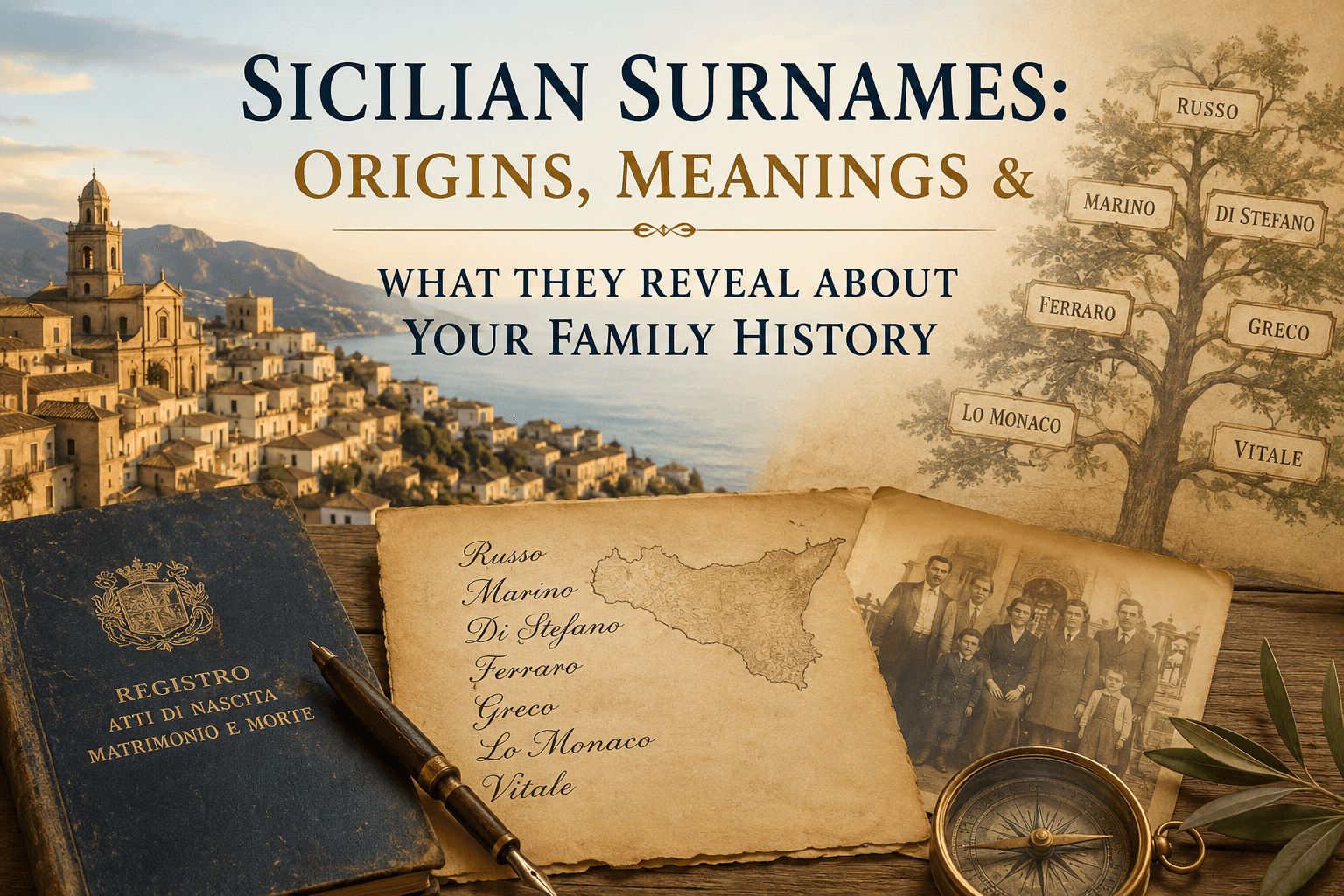
Sicilian Surnames: Origins, Meanings & Family History Guide
Sicilian Surnames: Origins, Meanings & Family History Guide
For many people beginning their Sicilian genealogy journey, a family surname is the first clue connecting them to their ancestral roots.
A surname can reveal where a family lived, what work they performed, a physical characteristic of an ancestor, or even a nickname that survived for centuries.
Understanding the origin and meaning of Sicilian surnames can provide valuable context when researching family records and identifying the towns where ancestors once lived.
If you're just starting your research, we recommend reading:
➔ How to Trace Sicilian Ancestors: Complete Beginner's Guide (2026
which explains the first steps to discovering your family's Sicilian origins.
How Sicilian Surnames Developed
Most hereditary surnames became common in Sicily between the Middle Ages and the 16th century.
As populations grew, first names alone were no longer sufficient to identify individuals. Families began adopting surnames based on:
● occupations
● places of origin
● personal characteristics
● parents' names
● nicknames
Over generations, these names became permanent family identifiers and were recorded in church and civil records.
Today, many Sicilian family names remain concentrated in specific regions and towns, making them valuable clues for genealogy research.
Common Types of Sicilian Surnames
Occupational Surnames
Some Sicilian surnames originated from an ancestor's profession.
Examples include:
● Ferraro – blacksmith
● Barone – noble or estate manager
● Marino – sailor or fisherman
● Pastore – shepherd
These surnames can offer insight into the social and economic background of a family.
Patronymic Surnames
Patronymic surnames are derived from a father's given name.
Examples include:
● Di Giovanni
● Di Marco
● D'Angelo
● Lo Monaco
These names often indicate descent from a particular ancestor.
Geographic Surnames
Many Sicilians adopted surnames connected to a town, region, or geographic feature.
Examples include:
● Messina
● Palermo
● Catania
● Calabrese
Such surnames may indicate where a family originally lived before relocating.
Descriptive Surnames
Some surnames began as nicknames describing physical traits or personality characteristics.
Examples include:
● Russo – red-haired
● Biondo – blond
● Grasso – large or stout
● Gentile – kind or noble
These names often originated from how a person was recognized within a local community.
Common Sicilian Last Names and Their Meanings
Many people researching their ancestry begin by searching for common Sicilian last names and their meanings.
While the exact origin of a surname may vary from one family to another, some Sicilian surnames have well-known historical meanings.
Sicilian Surname ➨ Meaning or Origin
Russo ➨ Originally referred to someone with red hair
Lombardo ➨ Family with origins in northern Italy
Greco ➨ Connected to Greek ancestry or influence
Caruso ➨ Traditionally associated with a young worker or apprentice
Ferraro ➨ Blacksmith
Marino ➨ Sailor or someone connected to the sea
Catalano ➨ Family linked to Catalan origins
Vitale ➨ Derived from the personal name Vitale
Rizzo ➨ Often associated with curly hair
Messina ➨ Family originating from the city of Messina
Understanding the meaning of a surname can provide valuable clues when beginning Sicilian genealogy research, although documentary evidence is always needed to confirm family connections.
Why Surnames Matter in Genealogy Research
A surname alone cannot identify your exact ancestral town, but it can provide important clues.
Researchers often use surnames to:
● narrow geographic regions
● identify spelling variations
● distinguish unrelated families
● connect historical records across generations
When combined with official records, surname research becomes even more powerful.
Birth, marriage, and death certificates often provide the evidence needed to connect generations and confirm family relationships.
To learn where to find these records, read:
➜ How to Find Italian Birth, Marriage & Death Records in Sicily (2026 Guide)
Common Sicilian Surname Variations
One challenge genealogists frequently encounter is surname variation.
Examples include:
● Di Stefano / De Stefano
● Catania / Cataniah
● Marino / Marini
● Russo / Ross
Immigration officials, language differences, and handwritten records often caused surnames to change over time.
When researching ancestors, always search for multiple spelling variations.
Many genealogy databases allow searches using alternate spellings and historical record indexes.
Our guide:
➔ Best Online Resources for Sicilian Genealogy Research (2026 Guide)
explains which websites and archives are most useful for finding Sicilian family records online.
How to Search Sicilian Surnames
Many researchers look for a Sicilian surname search engine when trying to identify family origins.
While there is no single database containing every Sicilian surname, several resources can help you research a family name:
● Civil birth, marriage, and death records
● Church baptism and marriage registers
● Immigration and passenger lists
● Census records
● Online genealogy databases
Researchers should always search for multiple spelling variations, as surnames often changed over time due to immigration, translation, or transcription differences.
For a complete list of genealogy resources, read:
➔ Best Online Resources for Sicilian Genealogy Research (2026 Guide)
Can a Surname Reveal Your Ancestral Town?
Sometimes, but not always.
Certain surnames are strongly associated with specific provinces or towns.
However, migration within Sicily and international emigration spread many surnames across the island and around the world.
To accurately identify an ancestral town, researchers usually need additional evidence such as:
● birth certificates
● marriage records
● death records
● church registers
● immigration documents
Surname research should be viewed as a clue rather than definitive proof of origin.
Old Sicilian Surnames and Historical Influences
Sicilian surnames reflect centuries of cultural influences that shaped the island.
Many family names can trace their origins to:
● Greek settlements
● Roman administration
● Arab rule
● Norman conquest
● Spanish and Aragonese influence
Because Sicily has been a crossroads of Mediterranean civilizations for thousands of years, some surnames preserve traces of these historical periods.
Understanding the historical background of a surname can sometimes provide additional clues about a family's distant origins and migration history.
Some of the Most Common Sicilian Surnames
While thousands of surnames exist throughout Sicily, some are particularly widespread across the island.
Examples include:
● Russo
● Marino
● Lombardo
● Caruso
● Greco
● Messina
● Vitale
● Ferraro
● Rizzo
● Catalano
These names often appear in historical records dating back centuries.
However, having a common surname can make genealogy research more challenging, making it even more important to gather supporting records and family information.
If you're still at the beginning of your journey, our article:
➥ How to Trace Sicilian Ancestors: Complete Beginner's Guide (2026)
can help you build a solid research strategy.
How a Sicily Genealogy Tour Can Help
Many descendants reach a point where online records only tell part of the story.
Before visiting Sicily, many researchers begin by studying their family surname and tracing historical records.
Helpful resources include:
➔ How to Trace Sicilian Ancestors: Complete Beginner's Guide (2026)
➔ How to Find Italian Birth, Marriage & Death Records in Sicily (2026 Guide)
➔ Best Online Resources for Sicilian Genealogy Research (2026 Guide)
Visiting ancestral towns can provide a deeper understanding of family history by allowing you to:
● walk the streets where ancestors lived
● visit local churches and archives
● explore cemeteries and historic neighborhoods
● connect family records with real places
➔ Sicily Genealogy Tour: A Real Family Heritage Journey Through Sicily
transforms names and documents into a meaningful family heritage experience, helping descendants reconnect with the places their families once called home.
Conclusion
Sicilian surnames are more than family names—they are historical clues that can help uncover centuries of family history.
By understanding the meaning and origin of a surname, researchers can gain valuable context for tracing ancestors, locating records, and discovering ancestral communities throughout Sicily.
While a surname alone rarely provides all the answers, it can serve as an important starting point for building your family tree and identifying where to continue your research.
Ready to continue your genealogy journey?
Explore these related resources:
➔ How to Trace Sicilian Ancestors: Complete Beginner's Guide (2026)
➔ How to Find Italian Birth, Marriage & Death Records in Sicily (2026 Guide)
➔ Best Online Resources for Sicilian Genealogy Research (2026 Guide)
➔ Sicily Genealogy Tour: A Real Family Heritage Journey Through Sicily
Together, these guides can help you move from family stories and surnames to documented Sicilian ancestry and real ancestral places.
FAQ
What are the most common Sicilian surnames?
Some of the most common Sicilian surnames include Russo, Marino, Lombardo, Caruso, Greco, Vitale, Messina, Ferraro, Rizzo, and Catalano.
What do Sicilian last names mean?
Many Sicilian last names originated from occupations, geographic locations, personal characteristics, or family relationships. Examples include Ferraro (blacksmith) and Russo (red-haired).
Can a surname tell me where my family came from in Sicily?
Sometimes. Certain surnames are more common in specific provinces, but official records are usually needed to confirm an exact ancestral town.
Why do Sicilian surnames have different spellings?
Surname variations often occurred because of immigration, language differences, transcription errors, and handwritten historical records.
Are Sicilian surnames useful for genealogy research?
Yes. Surnames can provide clues about family origins, occupations, migration patterns, and ancestral communities, especially when combined with historical records.
Is there a Sicilian surname search engine?
There is no single Sicilian surname database, but researchers can use civil records, church registers, immigration documents, and genealogy websites to investigate family names.
What should I do if my family's surname changed after immigration?
Research all known spelling variations and compare records across different sources. Immigration documents, census records, and civil registrations can often reveal the original surname used in Sicily.
Ready to discover Sicily?
Turn inspiration into reality. Explore our curated private tours or build a custom itinerary matching your interests.